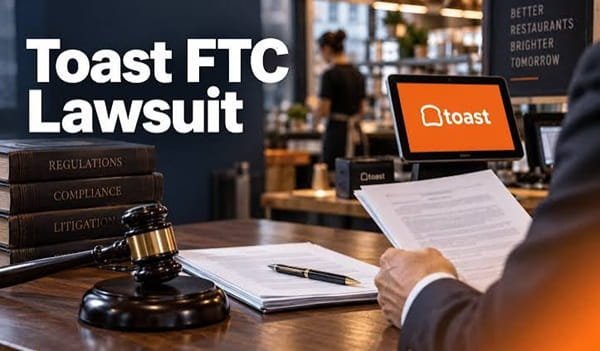
The Federal Trade Commission and a coalition of state and local authorities sued Toast Inc. on October 29, 2026, accusing the restaurant technology company of using misleading subscription terms, charging unauthorized fees and making it unnecessarily difficult for businesses to leave its services. The action concerns the software and payment-processing systems that many restaurants use every day. At issue is whether businesses clearly understood the full cost of their contracts, the practical steps required to cancel and the limits of the support Toast advertised.
Filed in the U.S. District Court for the Northern District of California, the Toast FTC lawsuit seeks court orders, monetary relief and civil penalties. Toast rejects the accusations and says regulators are trying to apply an online subscription law to negotiated commercial contracts. That disagreement is central to the case. As of November 16, 2026, the complaint remains pending, with no judgment establishing wrongdoing, no approved settlement and no consumer-claims process arising from this lawsuit.
Who Filed the Toast FTC Lawsuit and Why
The FTC brought the case with the attorneys general of Colorado, Florida, Illinois, Iowa, Nebraska, Oklahoma and Utah, together with officials acting for Los Angeles County and San Francisco. The defendants include Toast Inc. and affiliated businesses connected with its restaurant-management products. The case, Federal Trade Commission et al. v. Toast, Inc. et al., carries docket number 3:26-cv-12705.
Toast sells point-of-sale systems, software subscriptions and payment services used to take orders, manage employees, process transactions and operate restaurants. Some subscriptions last one or two years and are billed monthly. Regulators argue that the company’s enrollment, billing and cancellation practices exposed business customers to obligations they did not clearly agree to. The complaint also addresses charges imposed on diners using certain online ordering services.
Allegations About Hidden Fees and Unwanted Add-Ons
According to the complaint, restaurants sometimes found additional software or services on their accounts without giving informed consent. The FTC also challenges the presentation of Toast’s ‘Pay-as-you-Go’ offering, which advertised hardware and software at no monthly charge while charging higher transaction fees and, regulators say, leaving other obligations insufficiently disclosed.
The government points to several specific conditions. A business that did not begin processing payments within 120 days allegedly had to return its equipment or pay its retail value. Restaurants temporarily unable to operate could still face an $85 monthly payment-processing charge. The complaint also describes an early termination amount calculated at $150 for each remaining contract month. These are alleged contractual consequences, not charges that every Toast customer necessarily paid.
Another allegation concerns a 99-cent fee that Toast reportedly added to certain online orders exceeding $10 between September 2021 and late July 2023. Regulators say restaurants and diners were not adequately informed that the fee went to Toast. The complaint asks the court to assess whether the disclosures and consent procedures complied with applicable law.
Cancellation Problems and Toast Capital Loans
Cancellation is a separate focus of the lawsuit. Regulators contend that some restaurant owners had to provide written notice at least 30 days before renewal, then navigate customer-service teams, follow-up calls and retention offers. The complaint describes reports of customers continuing to receive bills after requesting cancellation. One cited customer allegedly received an early termination demand exceeding $5,300 after leaving the platform.
The government’s account also connects cancellation to Toast Capital financing. It alleges that certain loan agreements treated leaving Toast or switching providers as a trigger for immediate repayment of the unpaid loan balance. For a restaurant already under financial pressure, that condition could make changing payment systems unusually costly. Whether the relevant provisions were properly disclosed, legally enforceable or unfair is for the court to determine.
Customer Support Claims and the Laws at Issue
The complaint challenges Toast’s repeated promises of round-the-clock support. According to regulators, some customers could not reach staff able to resolve payment or software problems on weekends or outside normal business hours. One example describes a restaurant that allegedly lost substantial credit-card sales after learning that the team needed to fix its problem was unavailable on a Saturday.
The FTC asserts claims under Section 5 of the Federal Trade Commission Act, which addresses unfair or deceptive business practices, and the Restore Online Shoppers’ Confidence Act, commonly known as ROSCA. The government plaintiffs also rely on related state consumer-protection laws. They seek prospective changes to the challenged practices and financial remedies. The complaint does not itself establish that any alleged conduct violated these statutes.
Toast Response, Court Schedule and What Happens Next
Toast strongly disputes the complaint. In an October 29 statement, it said regulators had overlooked evidence that restaurant customers negotiate their agreements. The company argues that ROSCA was designed for certain online consumer subscriptions and should not be extended to negotiated business-to-business contracts. Toast says it cooperated with the FTC investigation beginning in 2025 and tried unsuccessfully to resolve the matter before litigation.
Toast’s November 2026 securities filing confirms that the complaint seeks a permanent injunction, unspecified monetary relief and civil penalties. The company says it cannot reliably estimate a potential loss at this stage. The public docket lists a case-management statement due January 21, 2027, and an initial conference set for January 28, 2027, subject to later court changes.
For restaurants, the legal question is not simply whether an individual fee appears in a contract. The case will examine what customers were told before enrolling, whether charges were authorized and whether cancellation procedures met governing legal standards. Any compensation program would depend on future court orders or a settlement; none had been announced as of November 16, 2026.